Transitions, Promotions, and Discharging the Loyal Soldier–An Idea to Try On…

James Robinson • July 10, 2024

Say goodbye to old roles with dignity and honor. Invite people into their new roles with clarity and excitement!
A few years ago, I was recommended the book Falling Upward by Richard Rohr–  a Franciscan friar, mystic and founder of the Center for Action and Contemplation. 


Prior to this recommendation, I’d seen some of his videos about Enneagram typology. My team loved the Enneagram assessment and found it a good entry point for understanding their peers. 


When I learned Father Rohr is considered a “mystic”, I  found myself skeptical, uneasy, and a bit triggered. Back then,  I perceived myself as a data and analysis guy. Mysticism went against all of that. However, when reading the text, I found there were more “A Ha” moments than not.  One of those “A Ha” moments came from reading the story of discharging the loyal soldier. 


During WWII, communities in Japan conducted a ceremony for soldiers re-entering society after finishing their wartime obligations. To help with this transition, the soldiers were honored and praised for their war efforts. After being honoring the soldier, an esteemed elder spoke-- directing the soldier to let go of the war, while providing expectations for their reentry into society as peaceful and productive citizens. 


There was clarity, honor, and a separation made between the past and the future. It dawned on me that we don’t do this enough in our organizations. 


As such,  I found myself jotting questions:

  • What could a Discharging Your Loyal Teacher ritual look like for a person promoted out of the classroom and into the position of Assistant Principal or coach? How about  for principals becoming principal managers or leaders transitioning out of the organization to pursue new challenges?


Implementing rituals and ceremonies for Discharging the Loyal Soldiers within organizations could benefit us all:


BENEFITS 

  • Honoring the Past:  This is healthy for everyone. Sharing past triumphs and accomplishments feels good for the honoree and all other people in the room. Add gratitude, and it's even better!
  • Clarity on Expectations :  Because the loyal soldier is being discharged and transitioning to a new role, clarity of those expectations is important for everyone involved.  Had the Japanese soldiers of WWII only been praised and discharged without expectations for the future, there may not have been any  transition in any real sense of the word. Instead, the soldier may have gone out into the world as a soldier during peacetime, which could be dangerous.  The same could happen in organizations as staff are promoted to new roles, but remain unclear as to what the expectations of the role are
  • Separation and Integration: I’ve used the rearview mirror vs windshield analogy often. As a rule, I used the analogy to focus my team more on the future during data talks or staff meetings. I aimed for a ratio of 80% future-focused talk and planning VS 20% past.  Looking at the past, we mined for strengths, replicable actions, and root causes. The rest of the time was future-facing, vision setting, and getting clear on expectations while inspiring hope.  A Discharging the Loyal Soldier ceremony should do the same.


Decorum and Structures


I’m a fan of decorum, structures and formalities when it comes to organizational rituals. If done well, they feel like secular holidays that employees look forward to a few times a year. Over my tenure in charter schools, I’ve been very fortunate to work for organizations that do this well, and I’ll share those experiences soon in another post. Until then, here are a few things to consider when setting up a ceremony :


  • Have Witnesses : We all love transparency. By holding the ceremony in front of an audience, onlookers can learn how to rise to the next level while becoming clearer as to what is expected of different positions at that particular time. Moreover, it may give people a goal to strive for, a personal vision for excellence while pursuing their personal mythology. 
  • Be Formal: Have you ever been invited to a party or event, then show up and there’s no balloons nor decorations to signify its importance?  I have, and it feels like any other day.  Ceremonies should feel different– there should be something pattern-breaking about them so as to become memorable,  desirable and something people look forward to .
  • Provide Tokens and Symbols: A token or symbol goes a long way in a ceremony. Be sure to provide honorees with something soulful to hold onto during the tough times , when the person needs to remember the new role that he or she has taken on . 


If your organization has a  promotion ceremony for staff, I’d love to hear about it. Just reply in the comments or send me a note. 


And if your organization would like to collaborate to create a ceremony unique to your people and needs,  send me a note.
By James Robinson March 7, 2026
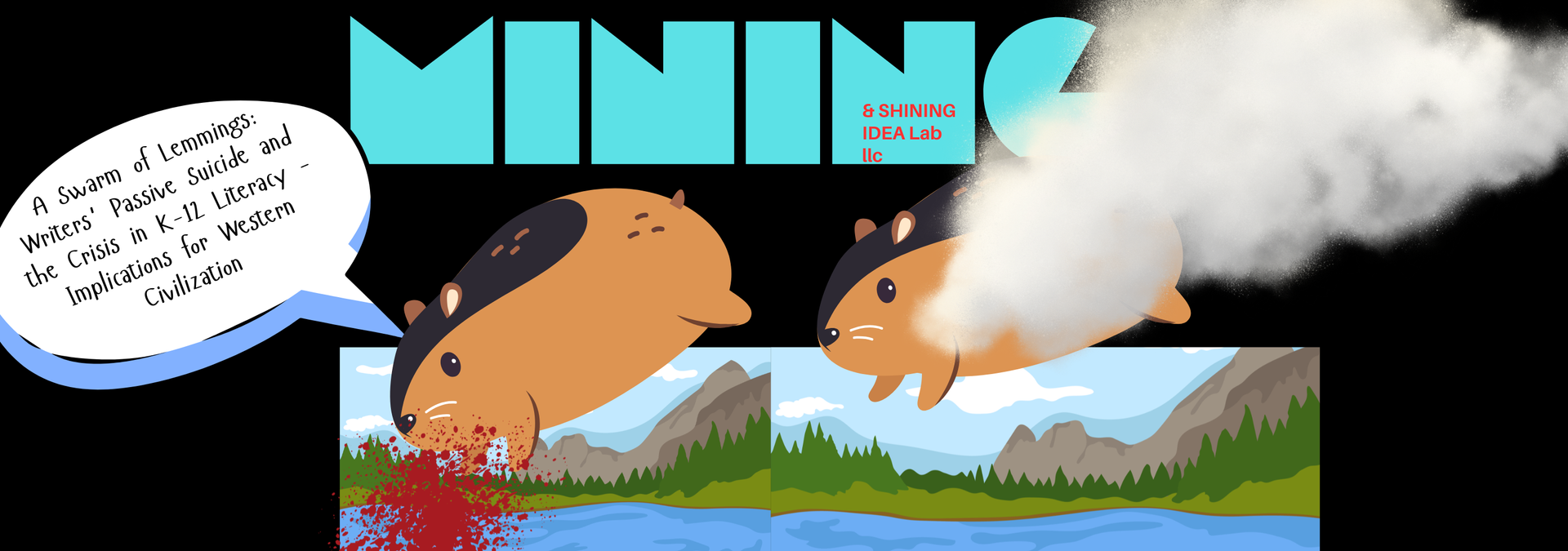
A swarm of lemmings continues their march to the proverbial sea, attracted by a temporary vision of sun and beauty, but ultimately distracted by that vision—thus, they fall off the cliff in a passive suicide. It wasn’t a conscious decision. Their deaths were the consequence of distraction alone. In this allegory, the lemmings are writers (and many in publishing) who ignore the erosion in elementary schools and K-12 education. Writers may create brilliant work, but if students graduate without the skills to engage deeply, our audience vanishes. From a cultural perspective, this is alarming—and the stakes extend to the health of Western civilization itself. In my day job, as Executive Director of a small non-profit, I oversee a pre-K program, a charter school, and our efforts to revitalize a publishing company re-dedicated to high-quality children's books, which we're strongly considering. These trends hit close to home: we're building foundations early because the data shows the stakes are high—not just for individuals, but for the shared knowledge, critical reasoning, and civic discourse that have sustained Western democratic traditions for centuries. Key trends: Average Grade Level of Books Sold Now vs. 1950: Decline Toward Grade 5–7 Bestsellers today often score 5th–7th grade on Flesch-Kincaid (many 4th–6th for broad appeal), with simpler sentences and vocabulary to match declining adult reading stamina. Mid-20th-century works frequently demanded more (closer to 7th–9th in analyses), reflecting a market shift toward accessibility amid falling literacy. Didactic vs. Non-Didactic vs. Classics: Effects on Brain Development Narrative-driven reading (non-didactic stories or classics) sustains broader brain activation—engaging language, empathy, memory, and connectivity regions more effectively than passive or overly didactic methods. Neuroscience shows immersive storytelling promotes neuroplasticity and deeper neural pathways, while fragmented/instructional approaches may limit sustained engagement and cognitive depth needed for complex literature. If Trends Continue: What Will Texts Look Like in the Future—4th Grade? Pleasure reading has plummeted ~40% over 20 years (daily readers from 28% peak in 2004 to 16% in 2023); adult literacy scores dropped sharply (many below 6th grade); NAEP reading scores remain at historic lows. Unchecked, popular texts could simplify to 4th-grade or lower: basic vocabulary, short sentences, reduced nuance—eroding space for sophisticated writing. These declines threaten more than literacy: they undermine the foundations of Western civilization. Deep reading fosters critical thinking, empathy, and shared cultural references essential to informed citizenship and democratic debate. As reading wanes, societies risk shallower discourse, greater susceptibility to manipulation, weakened civic engagement, and a fraying of the reflective reasoning that has driven progress, innovation, and self-governance in the West. This isn't inevitable. Writers and creators bring storytelling, imagination, and engagement that schools and early programs need most. Call to Action: Get involved in schools and early education. Ask kids about the books you remember reading when you were a kid– The Oddyssey, Of Mice and Men, Leaves of Grass. Advocate for narrative-rich curricula, or support initiatives like ours in pre-K and charter settings. Or send me an email, I'd love to chat. When we relaunch our website in the summer, we'll have some exciting news. We have a lot of work to do-- and we're all learning from it.
By James Robinson February 21, 2026
Pushing and Pulling The "push" connotes aggression whereas the "pull" connotes invitation. The "push" is a criticism, and the "pull" is coffee and advice at a nice cafe selected just for the advisee. Both are needed in different measures, at different times and often towards the same ends. In 2024, I engaged in a sabbatical to step back, read, study, think, and reflect about schools and leading through the pandemic. It was a very prolific period. However, what made it prolific was the "push"-- spending days reviewing data and learning to criticize the sector I worked in. The Courage Gap Talks document those learnings, in the most lo-fi way. They're ugly, but they inform the work and solutions we're imlpementing at the park, where our goal is to "pull" folks into a transformative educational envioronment. Originally, they were called "Career-Suicide Notebooks", the original plan being to walk away from education all together. Instead, what I learned will inform my work for years. It's been said that Buddhist monks can see the world in a grain of rice. After being immersed in education for several years, I see the world in a school ecosystem. Thus, schools enter my creative work and the way I think about creativity enters my work in schools. The first video is called 33% and it looks at the proficiency scores of 4th grade students on the NAEP Assessment. Additionally, it looks at the broad economy that works to maintain the status quo.